Choosing the best Bathroom Vanity Lighting for 2026 starts with a simple question: can you see your face clearly, without harsh shadows? A bright fixture alone is not enough. Its position, color quality, and spread all matter. Light from both sides of a mirror can reduce shadows around the nose and chin, while a well-placed overhead fixture adds useful ambient light. Small details count.
Lighting designer Randall Whitehead has described lighting as “the jewelry of the home.” That idea suits a bathroom, where a fixture can shape the room’s character as well as its visibility. For a practical choice, compare light output, color rendering, dimming options, and how the fixture fits beside your mirror. Check the finish against faucets and cabinet hardware, too. A warm metal bar may look lovely, but it still needs to illuminate the sink evenly.
There is no universal winner. A narrow powder-room mirror needs something different from a wide double vanity, and ceiling height can limit fixture placement. Measure before shopping. Then consider your morning routine, existing wiring, and whether the light feels comfortable at night. Product specifications help, but they cannot show exactly how light will fall on your face. That takes a little testing—and sometimes a second look. This guide explores the features, styles, and installation considerations that can help you choose Bathroom Vanity Lighting for a real bathroom, not just a polished product photo.
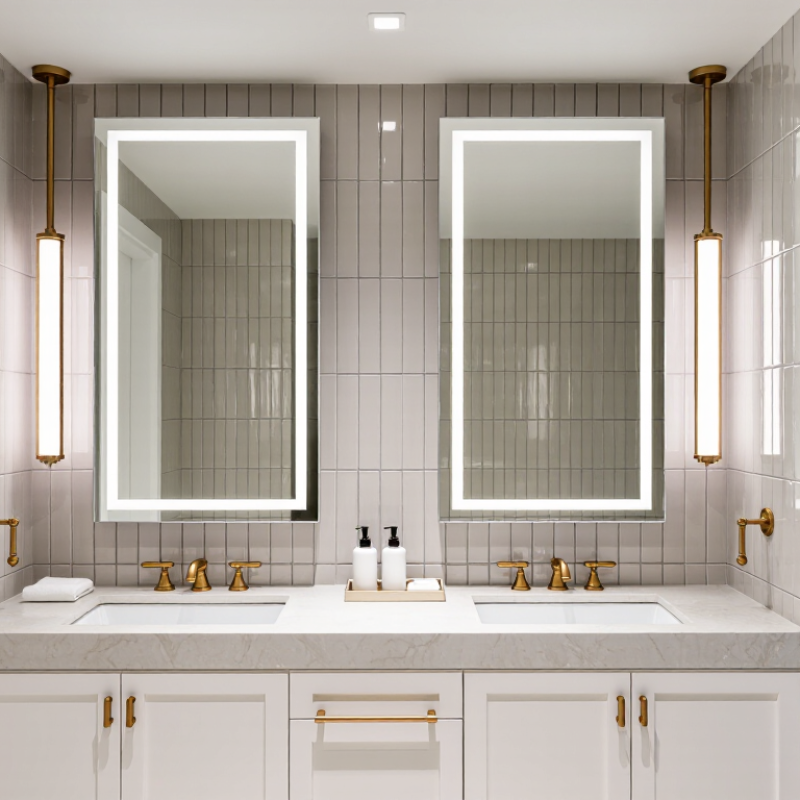
For 2026, define bathroom vanity lighting by the task, not the fixture trend. IES task-lighting guidance treats illuminance as activity-dependent; one brightness level does not suit every face, mirror, or room. For shaving, applying makeup, or checking skin, the face needs clear, balanced light. A bright countertop alone is not enough.
A single ceiling fixture can cast shadows under the eyes and chin. Where the layout allows, place vertical lights on both sides of the mirror, near face height. Choose diffused shades to soften glare, and check that the light reaches the face evenly when standing close. Small differences matter. Test the setup from seated height, too, if children or seated users share the bathroom.
Look for consistent color appearance and strong color rendering so skin tones do not look oddly dull or warm. Dimming can help the room shift from grooming to nighttime use, but it should not make the task light unusably faint. IES recommendations vary with the task and conditions, so treat a generic online brightness figure cautiously. A mock-up with temporary lights can reveal awkward shadows before installation; it may feel fussy, but it often catches what a showroom mirror cannot.
For balanced facial light, fixture position matters as much as brightness. Side-mounted sconces illuminate both sides of the face, softening shadows around the nose and eyes. Mount them near face height, with diffused shades and enough spacing to light the cheeks evenly. The Illuminating Engineering Society’s ANSI/IES RP-2-20 guidance treats residential lighting as task-specific; mirror lighting deserves its own careful plan. Small detail, big difference.
An over-mirror fixture can work well when wall space is limited. Choose a wide, diffused light rather than a narrow, exposed source. A single downward beam may leave eye sockets dark, especially when the fixture sits high above the mirror. Check the effect at the actual mirror: lean in, step back, and look at your face from different angles. Perfect on paper can still feel harsh at 7 a.m.
When possible, combine side lights with a gentle overhead source, and use dimming to adapt for grooming and nighttime routines. The U.S. Department of Energy reports that LEDs use at least 75% less energy and last up to 25 times longer than incandescent lighting. That makes efficient LEDs a practical choice, but efficiency alone does not guarantee flattering light. Review color appearance and diffusion in person; even thoughtful layouts can feel slightly uneven in a small bathroom.
At a bathroom vanity, color accuracy matters when matching foundation, checking skin tone, or spotting a missed shave. Choose a high-quality light source with a color rendering index (CRI) of 90 or higher. The U.S. Department of Energy describes CRI on a 0–100 scale, where higher values generally indicate more accurate color appearance. CRI is useful, but it cannot describe every aspect of how a lamp renders color.
For a clear, comfortable mirror view, aim for 3,000–4,000 K. Around 3,000 K feels warmer; 4,000 K looks more neutral and crisp. Keep the vanity light and other bathroom lamps close in color temperature, or your reflection may look different from the room.
IES TM-30-20 supplements CRI with fidelity and gamut measures, offering a fuller way to assess color rendering. Still, specifications cannot predict every face or finish. Light is personal. Test the fixture at the mirror before choosing, if possible.
Tips: Place light on both sides of the mirror, or use a broad, even fixture above it. Avoid bare bulbs that create sharp shadows under the eyes. Check your reflection in daylight, too.
For 2026, the best bathroom vanity lighting starts with safe placement, not just a flattering glow. The NEC distinguishes damp locations from wet locations. A fixture exposed to ordinary moisture may need a damp-location listing; one exposed to direct shower spray may require a wet-location listing. The exact requirements depend on the fixture’s position and the locally adopted code edition.
Pay special attention to the space around a tub or shower. NEC Article 410.10 includes rules for luminaires in these areas, and the required marking can change where spray reaches the fixture. Don’t assume a ceiling light is safe because it sits above the shower. Check the fixture label and installation instructions, then confirm placement with a qualified electrician or local inspector. Small details matter here.
At the vanity, vertical fixtures beside the mirror can cast more even light across the face than a single overhead source. Choose a damp-rated fixture if the location calls for it, and add diffused ambient lighting to soften shadows. A warm-neutral color temperature can make skin tones look natural without turning the room yellow. Still, mirrors, tile, and paint shift light in surprising ways. Test the actual setup before settling on it.
What Is the Best Bathroom Vanity Lighting for 2026?
LED efficiency is a strong starting point when choosing bathroom vanity lighting. The U.S. Department of Energy reports that LEDs use at least 75% less energy and last up to 25 times longer than incandescent lighting. These figures compare technologies, not every fixture under identical conditions. Actual savings depend on wattage, use, and product quality.
That matters. A pair of efficient LED fixtures can provide dependable daily light while reducing electricity use and replacement frequency. For clear grooming, check the fixture’s lumen output and color rendering, not just its wattage. A bright, cool-looking bulb can still make skin tones appear unnatural. Warm-to-neutral light often feels more comfortable around a mirror, though personal preference matters.
Position also counts. Lights on both sides of the mirror can reduce harsh facial shadows more evenly than a single overhead fixture. Still, check carefully: bathroom fixtures need an appropriate damp- or wet-location rating for their placement. Confirm LED dimmer compatibility before installation, since mismatched controls may cause flickering. The energy numbers are persuasive, but they cannot rescue poor placement or uncomfortable color. I would compare the light quality in person when possible; product descriptions rarely show the whole picture.
The U.S. Department of Energy reports that LEDs use at least 75% less energy and can last up to 25 times longer than incandescent lighting. This chart uses separate normalized indices for each comparison: incandescent lighting is set to 100 for energy use and 1 for lifespan.
Side lights can brighten both cheeks and soften shadows around the nose and eyes. Mount them near face height. Small adjustments matter.
Yes, especially when wall space is limited. Choose a wide, diffused fixture, then check your reflection from several angles. A high, narrow beam may leave eye sockets dark.
Around 3,000–4,000 K usually gives a comfortable mirror view. Lower values look warmer; higher values appear more neutral. Keep nearby bathroom lights similar.
Look for a CRI of 90 or higher for more accurate color appearance. It can help when checking skin tone or makeup, but it is not the whole story.
LEDs use at least 75% less energy and can last up to 25 times longer than incandescent lights. Actual savings vary. Check light quality, too.
No. Compare lumen output and color appearance as well. A bright bulb can still make skin tones look unnatural.
A dimmer can adjust light for grooming or nighttime routines. Confirm that the fixture and dimmer are compatible, or flickering may occur.
Confirm the fixture’s damp- or wet-location rating for its position. Test the light at your mirror if possible. Product descriptions can miss the feel of a real reflection.
Choosing the best Bathroom Vanity Lighting for 2026 starts with treating the mirror area as a task-lighting zone. Balanced illumination helps reduce distracting shadows, and fixtures mounted on both sides of the mirror can light the face more evenly than a single fixture above it. When side mounting is not practical, select an appropriately sized over-mirror fixture that spreads light across the face rather than concentrating it in one spot.
For clear, natural-looking grooming colors, look for a color rendering index (CRI) of 90 or higher and a color temperature between 3,000 and 4,000 K. Fixture placement should also match the bathroom’s moisture conditions: follow applicable NEC damp- and wet-location requirements and the fixture’s location rating. LED options can reduce energy use by about 75% and last up to 25 times longer than traditional incandescent lighting, making them an efficient choice for everyday use.