Choosing China’s top Hospitality Floor Lamps suppliers for hotels requires more than comparing catalog prices. It demands attention to lighting performance, material quality, production consistency, and after-sales communication. In a guest room, a floor lamp is not merely decorative. Its shade controls glare, its base affects stability, and its switch must feel dependable during daily use.
Experienced hotel buyers often inspect supplier portfolios, sample rooms, and completed hospitality projects. They also request samples before approving large orders. A brass-finished lamp may look elegant in photographs, yet its coating can appear uneven under warm lobby lighting. Small details matter. Cable length, plug standards, packaging strength, and replacement-part availability can influence hotel operations for years.
Reliable Chinese manufacturers usually provide clearer specifications, factory evidence, quality-control records, and practical customization options. However, supplier claims should not be accepted without verification. A polished website proves little. Factory audits, independent inspections, and documented testing offer stronger evidence. Communication deserves equal attention, especially when drawings change or delivery schedules become tight.
This guide examines how hotel developers, procurement teams, and interior designers can evaluate Hospitality Floor Lamps suppliers in China. It considers design flexibility, durability, certifications, production capacity, and service reliability. The process is not always smooth. Some promising suppliers may lack consistent export experience, while established factories may offer limited design creativity. Careful comparison remains essential, because the cheapest quotation can become the most expensive decision after installation.
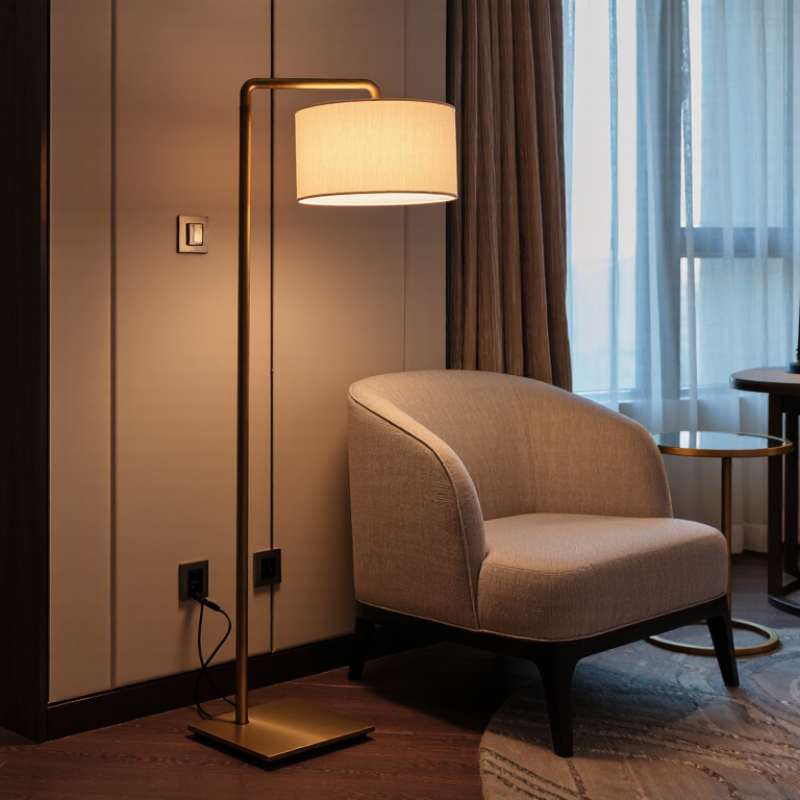
A quality hospitality floor lamp supplier in China understands hotel operations, not only metalwork. The lamp must look refined beside a lounge chair and survive daily handling. Ask for samples in the exact finish, shade fabric, and color temperature required. Small differences become obvious across twenty rooms.
Reliable suppliers share clear drawings, material specifications, and production schedules. Their engineers should explain base stability, cable routing, switch placement, and heat management in practical terms. Request test records for electrical safety and surface durability. Independent inspection can verify dimensions before shipment. It costs more, but rework costs more.
Experience appears in the questions a supplier asks. Do they confirm room layouts, socket positions, cleaning methods, and local voltage? Do they suggest safer packaging for ceramic or glass components? A strong supplier also offers spare parts and responds with traceable corrective actions. I have seen attractive samples fail because their bases scratched wooden floors. Appearance is not enough. No supplier gets every detail right. The useful difference is how openly they identify weaknesses and fix them. Clear communication, consistent batch quality, and honest lead-time updates make a supplier dependable for hotel projects.
| Evaluation Dimension | Practical Benchmark | What a Quality Supplier Should Provide | Why It Matters to Hotels | Recommended Verification |
|---|---|---|---|---|
| Product Safety Compliance | Applicable safety standard confirmed for the destination market | Test reports or certificates covering electrical safety, insulation, earthing, heat resistance, and mechanical stability. IEC 60598-1 is a common international reference for luminaires. | Reduces electrical, fire, and liability risks in guest rooms, corridors, lounges, and public areas. | Document review |
| Input Voltage and Frequency | Configured to the hotel project specification | Clear labeling for voltage, frequency, wattage, lamp type, and replaceable or integrated light source. Mainland China commonly uses 220 V and 50 Hz, while export markets may differ. | Prevents incompatibility, premature failure, and installation problems at the hotel site. | Label inspection |
| Light Output | Approximately 800–2,000 lumens for many decorative and reading floor-lamp applications | Provides measured lumen output, beam angle, color temperature, and light-distribution information rather than only LED wattage. | Helps designers achieve suitable ambient, reading, or task lighting without excessive glare. | Photometric report |
| Color Temperature | Approximately 2,700–3,000 K for warm hotel interiors | Offers stable warm-white options and confirms the actual color-temperature tolerance in production. | Supports a comfortable, welcoming atmosphere in bedrooms, suites, restaurants, and reception areas. | Sample comparison |
| Color Rendering | CRI ≥80 for general hospitality use; higher CRI where material and décor appearance is critical | States the color-rendering index and, when required, provides separate R9 performance information for saturated red tones. | Improves the appearance of fabrics, wood, artwork, food, and interior finishes. | Lighting test report |
| Flicker Performance | Low-flicker driver specified for guest comfort | Uses a suitable LED driver and discloses available flicker or modulation measurements under the intended dimming condition. | Reduces visual discomfort and supports a more comfortable guest experience in areas used for reading or relaxation. | Driver test |
| Material and Finish Quality | Consistent finish across the approved production sample | Identifies materials such as steel, aluminum, brass, glass, fabric, or wood; controls coating adhesion, color consistency, scratches, corrosion, and sharp edges. | Maintains the appearance of the hotel interior during frequent cleaning and daily use. | Pre-shipment inspection |
| Structural Stability | Stable base with no noticeable rocking during normal operation | Provides a weighted base, secure pole joints, protected cable routing, and a design that resists tipping when used as intended. | Important for guest safety, housekeeping operations, and installations near beds or seating areas. | Physical test |
| Ingress Protection | Indoor decorative lamps commonly require basic indoor protection; damp locations need an appropriate IP rating | States the actual IP rating and restrictions. Products intended for bathrooms, spa areas, or semi-outdoor locations should be assessed separately. | Helps prevent moisture-related failures and ensures the lamp is used only in suitable environments. | Application review |
| Dimming and Controls | Control method matched to the project, such as inline switch, wall switch, touch control, or compatible dimming system | Confirms driver compatibility, minimum dimming level, memory function, switch durability, and installation requirements. | Allows lighting scenes to match guest preferences, room automation, and hotel operating procedures. | Compatibility test |
| Repair and Maintenance | Replaceable service parts identified before order approval | Provides access to replacement drivers, switches, shades, cords, fasteners, and other wear components, with clear service instructions. | Extends product life and reduces maintenance costs when lamps are installed across many rooms. | Spare-parts list |
| Customization Capability | Customization based on approved drawings and physical samples | Supports adjustments to dimensions, finishes, shades, switches, plugs, cables, packaging, and lighting specifications while controlling engineering changes. | Enables the floor lamp to match the hotel’s interior design and technical requirements. | Sample approval |
| Quality Control Process | Documented inspection at incoming, in-process, and final stages | Uses inspection records for dimensions, appearance, electrical function, grounding, insulation, packaging, and quantity accuracy. | Reduces variation between the approved sample and the mass-production shipment. | Factory audit |
| Packaging and Transit Protection | Packaging tested against the product’s fragility and shipping route | Uses suitable internal cushioning, edge protection, moisture control where necessary, clear assembly instructions, and carton identification. | Minimizes damage, missing parts, and installation delays during international transport. | Packaging trial |
| Production Lead Time | Confirmed separately for samples, repeat orders, and customized production | Provides a written production schedule, approval deadlines, material-purchasing milestones, and shipment-ready dates. | Supports hotel opening schedules, renovation plans, and phased room installations. | Order schedule |
| Warranty and After-Sales Support | Written warranty terms with defined exclusions and response procedures | Specifies warranty duration, covered components, claim evidence, replacement policy, technical support, and spare-part availability. | Provides a clear remedy for defects and simplifies long-term hotel maintenance. | Contract review |
| Export and Documentation Capability | Complete commercial and technical documents prepared for the destination market | Supplies product specifications, packing lists, invoices, installation instructions, compliance documents, and destination-specific plug or labeling details. | Reduces customs, receiving, installation, and regulatory-documentation risks. | Documentation check |
| Sustainability Information | Material and energy information available on request | Discloses LED service-life assumptions, power consumption, packaging materials, repairability, and restricted-substance information where applicable. | Supports hotel sustainability targets, purchasing policies, and lifecycle-cost analysis. | Supplier questionnaire |
Note: Benchmarks are practical sourcing references for hospitality projects. Final requirements should be confirmed against the hotel’s destination-market regulations, project drawings, lighting calculations, and approved samples.
Look beyond metalwork and catalog prices. The supplier should understand guest comfort, hotel traffic, cleaning, and daily handling. Ask about room layouts, socket positions, local voltage, and maintenance routines. A beautiful sample is not enough.
Request drawings and a complete technical sheet. It should include dimensions, materials, socket details, power specifications, color temperature, and service life. Also confirm cable routing, switch placement, heat control, and base stability. Clear documents reduce costly misunderstandings.
Request a working sample in the approved finish, fabric, and color temperature. Keep one sample at the installation site. A slightly different shade can look obvious across twenty rooms. Small differences become expensive.
Inspect the lamp beside a chair or bedside table. Test base stability, switch feel, shade alignment, cord length, and heat control. Check whether the base scratches a wooden floor. Repeat the handling test.
Request material certificates, wiring photographs, and a production timeline. An independent inspector can check dimensions, surface defects, electrical safety, and packaging strength. Critical electrical items need tighter checks than appearance alone. Random inspection may miss repeated faults.
Confirm quantities, height, shade diameter, socket type, plug standard, finish, and delivery milestones. The signed sample should match the approved drawing. Write down tolerances, warranty terms, and replacement responsibilities. Verbal promises are weak.
Ask for carton dimensions, gross weight, shipping marks, and loading photographs. Use protective foam around ceramic or glass components. Review the carton list before dispatch. Packaging needs protection, not pointless plastic.
Yes, but the quantity should match project risk. Keep spare shades, cables, switches, or complete lamps when practical. Ask how quickly replacements can ship. A few spares help.
Check hospitality project experience, installation photos, production records, and comparable references. Visit the factory or arrange a documented remote audit. Notice how clearly the supplier reports delays and corrective actions. No checklist catches everything.
Be cautious when replies are slow before ordering. Very low prices may hide weak metal, uneven finishes, or poor cartons. A short final cable can make an attractive sample unusable. I could still miss something.
Selecting the right Chinese supplier for Hospitality Floor Lamps requires more than comparing prices. A quality supplier should understand hotel design requirements, offer stable product performance, and provide reliable communication from concept to delivery. Common hotel floor lamps include reading lamps for guest rooms, decorative lamps for lobbies, adjustable task lamps for work areas, and ambient lighting for restaurants or lounges. Each type should balance appearance, functionality, energy efficiency, and ease of maintenance.
When evaluating manufacturers, buyers should review customization capabilities, material options, lighting performance, safety testing, production capacity, and experience with hospitality projects. Clear specifications for dimensions, finishes, cables, switches, color temperature, and packaging can reduce misunderstandings. A dependable ordering process should include sample approval, pre-production confirmation, quality inspections, and careful protection during shipping. By assessing manufacturing consistency, logistics planning, and after-sales support, hotel purchasers can choose a supplier capable of delivering attractive, safe, and durable floor lamps for different hospitality environments.