Choosing China’s top Senior Living Lighting Fixtures manufacturers requires more than comparing prices or polished catalogs. In eldercare spaces, lighting affects orientation, comfort, nighttime safety, and daily routines. A corridor may need even illumination, while a resident’s room needs softer, controllable light. Glare on a glossy floor can create confusion. Flicker can also disturb sensitive residents.
Dr. Mariana Figueiro, a leading researcher in lighting and aging, has stated, “Light is the most powerful synchronizer of the circadian system.” This principle gives manufacturers a serious responsibility. Suitable products should support visual clarity during the day and calmer environments at night. Quality suppliers should provide photometric data, glare-control options, color-temperature choices, flicker information, and reliable dimming performance. These details matter more than attractive product photos.
This guide examines Chinese manufacturers through practical evidence. It considers product design, manufacturing experience, customization capacity, testing procedures, certifications, warranty terms, and after-sales support. Factory audits and sample testing remain valuable. Marketing claims are not enough. A supplier may offer an excellent fixture but weak documentation. Another may provide dependable engineering but limited design flexibility. That difference deserves attention.
There is no single perfect manufacturer. Care environments vary widely. A memory-care center, rehabilitation hospital, and assisted-living apartment need different lighting strategies. Buyers should assess installation height, maintenance access, cleaning routines, emergency requirements, and resident comfort before selecting products. Small oversights can become expensive later. This review aims to make those decisions clearer, while recognizing that real-world performance still depends on careful specification and installation.
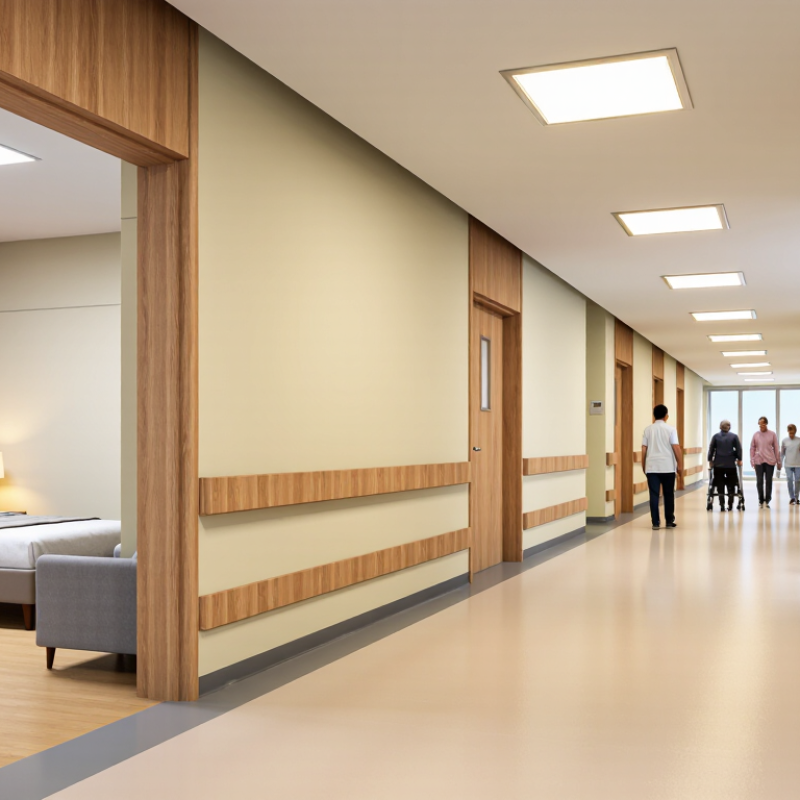
China’s senior living lighting fixtures manufacturing landscape is shaped by export experience, dense supply chains, and flexible production. Manufacturers commonly serve nursing homes, assisted-living apartments, hospitals, and accessible residential projects. Their products include bedside reading lights, corridor fixtures, bathroom luminaires, and low-glare ceiling panels.
Practical sourcing requires more than comparing prices. Senior-focused lighting should reduce glare, support clear wayfinding, and provide even illumination near beds and handrails. Adjustable color temperature can help residents follow daytime and nighttime routines. Motion sensors may improve safety in corridors, but poor calibration can cause irritating delays. Factory samples should be tested in furnished rooms, not only on a showroom wall.
Many Chinese manufacturers provide OEM and ODM services, including housing changes, dimming systems, emergency functions, and installation accessories. Reliable suppliers usually explain photometric data, ingress protection, driver performance, and electrical compliance for the target market. They should also provide aging tests and quality inspection records. This evidence matters more than polished catalog images.
The landscape is capable, but not flawless. Some factories still prioritize appearance over maintenance access. Others offer technical promises without long-term test results. Buyers should review sample consistency, spare-part availability, packaging strength, and after-sales procedures. A small detail matters: a difficult-to-replace driver can burden care staff for years. Clear specifications and staged inspections make the manufacturing relationship more dependable.
Product and manufacturing landscape overview for senior living, assisted living, nursing care, rehabilitation and memory-care facilities in China
| Manufacturing Segment | Typical Senior Living Applications | Common Product Specifications | Safety and Visual Comfort Features | Control and Integration Options | Relevant Standards and Compliance | Procurement Considerations |
|---|---|---|---|---|---|---|
| Patient-room ceiling fixtures | Bedrooms, assisted-care rooms, examination areas and private accommodation spaces |
LED output: approximately 1,500–4,500 lm Color temperature: 2,700–4,000 K Color rendering: CRI 80+; CRI 90+ often specified for care environments |
Low-glare diffuser or indirect component Flicker-controlled driver Smooth, cleanable housing with rounded edges |
On/off switching Dimming Bedside controls DALI or 0–10 V on larger projects |
IEC/EN 60598 series IEC 62471 photobiological safety CE and RoHS requirements for applicable export markets |
Confirm night-light function, maintenance access, emergency-lighting compatibility and acoustic requirements |
| Bedhead and reading lights | Reading, personal care, bedside orientation and resident-controlled lighting |
Typical reading output: 300–800 lm Color temperature: 2,700–4,000 K Beam angles commonly selected for localized task lighting |
Adjustable head or directional arm Low surface temperature Diffused light with minimal glare for older eyes |
Independent reading and ambient controls Touch, pull-cord or rocker switch Optional nurse-call or room-control interface |
IEC/EN 60598-1 Applicable low-voltage and electromagnetic-compatibility requirements RoHS for regulated markets |
Check mounting strength, cleanability, cable management and compatibility with medical or care equipment |
| Corridor and circulation lighting | Resident corridors, connecting passages, lift lobbies and transition zones |
Typical maintained illuminance target: about 100–200 lux, subject to local design standards Color temperature: 3,000–4,000 K Uniform, continuous illumination preferred |
Wide-beam optics Low glare and reduced shadowing Impact-resistant diffuser options for high-traffic areas |
Occupancy sensors Daylight harvesting Dimming schedules Central monitoring through DALI or compatible systems |
IEC/EN 60598 series Emergency-lighting provisions where required Applicable building and fire-safety codes |
Prioritize uniformity, easy relamping or driver replacement, and stable operation during frequent switching |
| Bathroom and wet-area fixtures | Resident bathrooms, assisted bathing rooms, shower areas and clinical hygiene spaces |
Typical protection rating: IP44–IP65 depending on installation zone Color temperature: 3,000–4,000 K CRI 80+; higher CRI useful for facial and skin-tone recognition |
Moisture-resistant enclosure Anti-corrosion finishes Diffused, shadow-reduced illumination near mirrors |
Wall switch Occupancy sensor Automatic night illumination Emergency-lighting interface where required |
IEC/EN 60598 IP classification under IEC 60529 Local electrical safety requirements for wet locations |
Verify the exact IP rating for the mounting zone, sealing method, condensation resistance and cleaning-chemical compatibility |
| Dining and communal-area lighting | Dining rooms, lounges, activity rooms, social spaces and multipurpose halls |
Typical maintained illuminance target: about 200–300 lux Color temperature: 2,700–3,500 K CRI 90+ commonly preferred for food presentation and skin-tone appearance |
Comfortable diffuse light Glare control for seated users Decorative and functional formats available |
Scene setting Dimming Daylight response Timed evening settings |
IEC/EN 60598 series EMC requirements Applicable energy-efficiency and building regulations |
Evaluate visual comfort from seated eye level, acoustic coordination, cleaning access and replacement consistency |
| Nurse-station and task lighting | Reception desks, nurse stations, medication preparation areas and administrative workpoints |
Typical maintained illuminance target: about 300–500 lux for detailed work Color temperature: 3,500–4,000 K CRI 80+; CRI 90+ for color-critical tasks |
UGR-conscious optics Uniform desk illumination Minimal screen reflections Stable output over long operating hours |
Individual dimming Presence detection Daylight-linked control Building-management integration |
IEC/EN 60598 IEC 62471 Applicable workplace-lighting and EMC requirements |
Request photometric files, glare data, driver lifetime information and compatibility with the project control protocol |
| Exterior and entrance fixtures | Entrances, covered walkways, gardens, drop-off areas, terraces and perimeter paths |
Typical protection rating: IP54–IP66 depending on exposure Typical impact ratings: IK08–IK10 where vandal resistance is needed Color temperature: 2,700–4,000 K |
Weather-resistant housing Slip-and-trip visibility support Controlled optics to limit glare and unwanted spill light |
Photocell control Motion sensing Astronomical time scheduling Central energy management |
IEC/EN 60598 IEC 60529 for ingress protection Relevant outdoor electrical and construction regulations |
Check corrosion resistance, drainage design, wind exposure, coastal suitability and spare-part availability |
| Emergency and wayfinding lighting | Escape routes, stairwells, lift lobbies, fire exits and directional wayfinding points |
Maintained or non-maintained configurations Typical emergency duration: 1–3 hours, subject to local code and project brief Self-contained or central-battery formats |
High-contrast exit legends Automatic changeover Battery monitoring Clear visibility for residents with reduced vision |
Self-test function Central monitoring DALI emergency reporting where supported Remote fault indication |
Local fire and emergency-lighting regulations IEC/EN 60598-2-22 ISO 7010 symbols where applicable |
Verify viewing distance, battery replacement cycle, test records, photometric spacing and authority approval requirements |
| Circadian-support and tunable-white systems | Memory-care areas, bedrooms, lounges and facilities seeking day-to-evening lighting variation |
Tunable range commonly around 2,700–6,500 K Adjustable output and scheduled scenes High color rendering available |
Gradual transitions to reduce visual discomfort Low-glare optics Consistent color matching between fixtures |
DALI-2 0–10 V Wireless controls Time-clock and sensor-based programming |
IEC/EN 60598 IEC 62471 EMC and radio requirements for wireless systems |
Specify commissioning responsibility, color consistency, fallback behavior, cybersecurity and staff override controls |
| Manufacturing and export capabilities | Custom lighting packages for new-build, renovation, hospitality-care and healthcare-adjacent projects | Common services include aluminum extrusion, die casting, powder coating, LED assembly, driver integration and photometric testing |
Sample approval and batch consistency Thermal management Surface-finish durability Traceable quality-control procedures |
Project-specific dimming and control integration Customized wiring, mounting kits and emergency options |
ISO 9001 quality systems are common in export-oriented manufacturing CE, RoHS, UKCA, FCC or other market approvals may apply by destination |
Compare MOQ, tooling charges, lead time, warranty terms, test reports, spare-driver policy and after-sales support |
Data note: The figures shown are representative industry ranges and design benchmarks rather than a ranking of individual manufacturers. Final lighting levels, ingress ratings, emergency duration, control protocols and certifications should be verified against the project brief, applicable national standards and the destination market’s approval requirements.
Common options include low-glare ceiling lights, bedside reading lamps, wall fixtures, corridor lights, and bathroom luminaires. Emergency lights and sensor-controlled systems may support shared areas.
Request sample units and test them beside beds, wheelchairs, handrails, and floor transitions. Check glare, flicker, shadows, and uneven bright spots. Drawings cannot show everything.
It should have an accessible switch, stable mounting, and focused light. The switch should respond clearly to light pressure. Small details matter.
Diffusers soften harsh reflections near beds and wheelchairs. They can make evening lighting feel calmer. However, an overly dense diffuser may reduce useful brightness.
Ask for photometric files, electrical test reports, material specifications, and installation guidance. Request current compliance evidence. Do not rely on claims alone.
Corridors need even illumination near handrails and floor changes. Emergency lighting should suit local building requirements. Suitable ingress protection matters in damp areas.
Adjustable color temperature can support active daytime routines and quieter evenings. Warmer light may feel comfortable but reduce visual clarity. Brighter light may improve visibility yet create glare.
Inspect wiring practices, thermal management, material handling, and production consistency. Review sample quality against actual production units. A polished showroom proves little.
Ask about cleaning routines, maintenance access, and replacement procedures. Dust can reduce light output and make fixtures look neglected. Maintenance is easy to underestimate.
They may notice glare, confusing shadows, or difficult switches quickly. Mock-ups reveal problems that technical drawings often miss. I would not approve a large order too soon.
China has become an important manufacturing base for Senior Living Lighting Fixtures, offering a broad range of products for nursing homes, assisted-living communities, rehabilitation centers, and other care environments. The industry focuses on practical designs that combine gentle illumination, low glare, energy efficiency, visual comfort, and dependable performance. Common product categories include ceiling lights, wall lights, bedside fixtures, corridor lighting, bathroom luminaires, emergency lighting, and smart control systems. These solutions can be adapted to different room layouts, mobility needs, and care routines.
When selecting a Chinese manufacturer, buyers should evaluate product quality, material durability, lighting consistency, installation flexibility, customization capabilities, and after-sales support. Safety and compliance are equally important, particularly for electrical protection, fire resistance, accessibility, emergency operation, and suitable brightness levels. A reliable supplier should provide clear technical documentation, quality-control procedures, testing information, sample evaluation, and stable production capacity. Careful communication about project requirements, delivery schedules, certifications, and warranty terms can help purchasers identify a manufacturer capable of delivering safe, comfortable, and long-lasting lighting solutions for senior living facilities.